 |
OpenCV
3.2.0
Open Source Computer Vision
|
|
OpenCV
3.2.0
Open Source Computer Vision
|
#include "tinyxml2.h"
Public Types | |
| enum | { OPEN, CLOSED, CLOSING } |
Public Member Functions | |
| virtual bool | Accept (XMLVisitor *visitor) const |
| const char * | Attribute (const char *name, const char *value=0) const |
| bool | BoolAttribute (const char *name) const |
| See IntAttribute() More... | |
| int | ClosingType () const |
| void | DeleteAttribute (const char *name) |
| double | DoubleAttribute (const char *name) const |
| See IntAttribute() More... | |
| const XMLAttribute * | FindAttribute (const char *name) const |
| Query a specific attribute in the list. More... | |
| const XMLAttribute * | FirstAttribute () const |
| Return the first attribute in the list. More... | |
| float | FloatAttribute (const char *name) const |
| See IntAttribute() More... | |
| const char * | GetText () const |
| int | IntAttribute (const char *name) const |
| const char * | Name () const |
| Get the name of an element (which is the Value() of the node.) More... | |
| char * | ParseDeep (char *p, StrPair *endTag) |
| int | QueryAttribute (const char *name, int *value) const |
| int | QueryAttribute (const char *name, unsigned int *value) const |
| int | QueryAttribute (const char *name, bool *value) const |
| int | QueryAttribute (const char *name, double *value) const |
| int | QueryAttribute (const char *name, float *value) const |
| XMLError | QueryBoolAttribute (const char *name, bool *value) const |
| See QueryIntAttribute() More... | |
| XMLError | QueryBoolText (bool *bval) const |
| See QueryIntText() More... | |
| XMLError | QueryDoubleAttribute (const char *name, double *value) const |
| See QueryIntAttribute() More... | |
| XMLError | QueryDoubleText (double *dval) const |
| See QueryIntText() More... | |
| XMLError | QueryFloatAttribute (const char *name, float *value) const |
| See QueryIntAttribute() More... | |
| XMLError | QueryFloatText (float *fval) const |
| See QueryIntText() More... | |
| XMLError | QueryIntAttribute (const char *name, int *value) const |
| XMLError | QueryIntText (int *ival) const |
| XMLError | QueryUnsignedAttribute (const char *name, unsigned int *value) const |
| See QueryIntAttribute() More... | |
| XMLError | QueryUnsignedText (unsigned *uval) const |
| See QueryIntText() More... | |
| void | SetAttribute (const char *name, const char *value) |
| Sets the named attribute to value. More... | |
| void | SetAttribute (const char *name, int value) |
| Sets the named attribute to value. More... | |
| void | SetAttribute (const char *name, unsigned value) |
| Sets the named attribute to value. More... | |
| void | SetAttribute (const char *name, bool value) |
| Sets the named attribute to value. More... | |
| void | SetAttribute (const char *name, double value) |
| Sets the named attribute to value. More... | |
| void | SetAttribute (const char *name, float value) |
| Sets the named attribute to value. More... | |
| void | SetName (const char *str, bool staticMem=false) |
| Set the name of the element. More... | |
| void | SetText (const char *inText) |
| void | SetText (int value) |
| Convenience method for setting text inside and element. See SetText() for important limitations. More... | |
| void | SetText (unsigned value) |
| Convenience method for setting text inside and element. See SetText() for important limitations. More... | |
| void | SetText (bool value) |
| Convenience method for setting text inside and element. See SetText() for important limitations. More... | |
| void | SetText (double value) |
| Convenience method for setting text inside and element. See SetText() for important limitations. More... | |
| void | SetText (float value) |
| Convenience method for setting text inside and element. See SetText() for important limitations. More... | |
| virtual XMLNode * | ShallowClone (XMLDocument *document) const |
| virtual bool | ShallowEqual (const XMLNode *compare) const |
| virtual XMLElement * | ToElement () |
| Safely cast to an Element, or null. More... | |
| virtual const XMLElement * | ToElement () const |
| unsigned | UnsignedAttribute (const char *name) const |
| See IntAttribute() More... | |
 Public Member Functions inherited from tinyxml2::XMLNode Public Member Functions inherited from tinyxml2::XMLNode | |
| void | DeleteChild (XMLNode *node) |
| void | DeleteChildren () |
| const XMLNode * | FirstChild () const |
| Get the first child node, or null if none exists. More... | |
| XMLNode * | FirstChild () |
| const XMLElement * | FirstChildElement (const char *value=0) const |
| XMLElement * | FirstChildElement (const char *value=0) |
| const XMLDocument * | GetDocument () const |
| Get the XMLDocument that owns this XMLNode. More... | |
| XMLDocument * | GetDocument () |
| Get the XMLDocument that owns this XMLNode. More... | |
| XMLNode * | InsertAfterChild (XMLNode *afterThis, XMLNode *addThis) |
| XMLNode * | InsertEndChild (XMLNode *addThis) |
| XMLNode * | InsertFirstChild (XMLNode *addThis) |
| const XMLNode * | LastChild () const |
| Get the last child node, or null if none exists. More... | |
| XMLNode * | LastChild () |
| const XMLElement * | LastChildElement (const char *value=0) const |
| XMLElement * | LastChildElement (const char *value=0) |
| XMLNode * | LinkEndChild (XMLNode *addThis) |
| const XMLNode * | NextSibling () const |
| Get the next (right) sibling node of this node. More... | |
| XMLNode * | NextSibling () |
| const XMLElement * | NextSiblingElement (const char *value=0) const |
| Get the next (right) sibling element of this node, with an optionally supplied name. More... | |
| XMLElement * | NextSiblingElement (const char *value=0) |
| bool | NoChildren () const |
| Returns true if this node has no children. More... | |
| const XMLNode * | Parent () const |
| Get the parent of this node on the DOM. More... | |
| XMLNode * | Parent () |
| const XMLNode * | PreviousSibling () const |
| Get the previous (left) sibling node of this node. More... | |
| XMLNode * | PreviousSibling () |
| const XMLElement * | PreviousSiblingElement (const char *value=0) const |
| Get the previous (left) sibling element of this node, with an optionally supplied name. More... | |
| XMLElement * | PreviousSiblingElement (const char *value=0) |
| void | SetValue (const char *val, bool staticMem=false) |
| virtual XMLComment * | ToComment () |
| Safely cast to a Comment, or null. More... | |
| virtual const XMLComment * | ToComment () const |
| virtual XMLDeclaration * | ToDeclaration () |
| Safely cast to a Declaration, or null. More... | |
| virtual const XMLDeclaration * | ToDeclaration () const |
| virtual XMLDocument * | ToDocument () |
| Safely cast to a Document, or null. More... | |
| virtual const XMLDocument * | ToDocument () const |
| virtual XMLText * | ToText () |
| Safely cast to Text, or null. More... | |
| virtual const XMLText * | ToText () const |
| virtual XMLUnknown * | ToUnknown () |
| Safely cast to an Unknown, or null. More... | |
| virtual const XMLUnknown * | ToUnknown () const |
| const char * | Value () const |
Friends | |
| class | XMLBase |
| class | XMLDocument |
Additional Inherited Members | |
| Protected Member Functions inherited from tinyxml2::XMLNode | |
| XMLNode (XMLDocument *) | |
| XMLNode (const XMLNode &) | |
| virtual | ~XMLNode () |
| XMLNode & | operator= (const XMLNode &) |
| Protected Attributes inherited from tinyxml2::XMLNode | |
| XMLDocument * | _document |
| XMLNode * | _firstChild |
| XMLNode * | _lastChild |
| XMLNode * | _next |
| XMLNode * | _parent |
| XMLNode * | _prev |
| StrPair | _value |
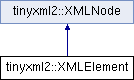
The element is a container class. It has a value, the element name, and can contain other elements, text, comments, and unknowns. Elements also contain an arbitrary number of attributes.
|
virtual |
Accept a hierarchical visit of the nodes in the TinyXML-2 DOM. Every node in the XML tree will be conditionally visited and the host will be called back via the XMLVisitor interface.
This is essentially a SAX interface for TinyXML-2. (Note however it doesn't re-parse the XML for the callbacks, so the performance of TinyXML-2 is unchanged by using this interface versus any other.)
The interface has been based on ideas from:
Which are both good references for "visiting".
An example of using Accept():
XMLPrinter printer;
tinyxmlDoc.Accept( &printer );
const char* xmlcstr = printer.CStr();
Implements tinyxml2::XMLNode.
| const char* tinyxml2::XMLElement::Attribute | ( | const char * | name, |
| const char * | value = 0 |
||
| ) | const |
Given an attribute name, Attribute() returns the value for the attribute of that name, or null if none exists. For example:
const char* value = ele->Attribute( "foo" );
The 'value' parameter is normally null. However, if specified, the attribute will only be returned if the 'name' and 'value' match. This allow you to write code:
if ( ele->Attribute( "foo", "bar" ) ) callFooIsBar();
rather than:
if ( ele->Attribute( "foo" ) ) {
    if ( strcmp( ele->Attribute( "foo" ), "bar" ) == 0 ) callFooIsBar();
}
| bool tinyxml2::XMLElement::BoolAttribute | ( | const char * | name | ) | const |
See IntAttribute()
| int tinyxml2::XMLElement::ClosingType | ( | ) | const |
| void tinyxml2::XMLElement::DeleteAttribute | ( | const char * | name | ) |
Delete an attribute.
| double tinyxml2::XMLElement::DoubleAttribute | ( | const char * | name | ) | const |
See IntAttribute()
| const XMLAttribute* tinyxml2::XMLElement::FindAttribute | ( | const char * | name | ) | const |
Query a specific attribute in the list.
| const XMLAttribute* tinyxml2::XMLElement::FirstAttribute | ( | ) | const |
Return the first attribute in the list.
| float tinyxml2::XMLElement::FloatAttribute | ( | const char * | name | ) | const |
See IntAttribute()
| const char* tinyxml2::XMLElement::GetText | ( | ) | const |
Convenience function for easy access to the text inside an element. Although easy and concise, GetText() is limited compared to getting the XMLText child and accessing it directly.
If the first child of 'this' is a XMLText, the GetText() returns the character string of the Text node, else null is returned.
This is a convenient method for getting the text of simple contained text:
<foo>This is text</foo>
    const char* str = fooElement->GetText();
'str' will be a pointer to "This is text".
Note that this function can be misleading. If the element foo was created from this XML:
<foo><b>This is text</b></foo>
then the value of str would be null. The first child node isn't a text node, it is another element. From this XML:
<foo>This is <b>text</b></foo>
GetText() will return "This is ".
| int tinyxml2::XMLElement::IntAttribute | ( | const char * | name | ) | const |
Given an attribute name, IntAttribute() returns the value of the attribute interpreted as an integer. 0 will be returned if there is an error. For a method with error checking, see QueryIntAttribute()
| const char* tinyxml2::XMLElement::Name | ( | ) | const |
Get the name of an element (which is the Value() of the node.)
|
virtual |
Reimplemented from tinyxml2::XMLNode.
| int tinyxml2::XMLElement::QueryAttribute | ( | const char * | name, |
| int * | value | ||
| ) | const |
Given an attribute name, QueryAttribute() returns XML_NO_ERROR, XML_WRONG_ATTRIBUTE_TYPE if the conversion can't be performed, or XML_NO_ATTRIBUTE if the attribute doesn't exist. It is overloaded for the primitive types, and is a generally more convenient replacement of QueryIntAttribute() and related functions.
If successful, the result of the conversion will be written to 'value'. If not successful, nothing will be written to 'value'. This allows you to provide default value:
int value = 10;
QueryAttribute( "foo", &value );        // if "foo" isn't found, value will still be 10
| int tinyxml2::XMLElement::QueryAttribute | ( | const char * | name, |
| unsigned int * | value | ||
| ) | const |
| int tinyxml2::XMLElement::QueryAttribute | ( | const char * | name, |
| bool * | value | ||
| ) | const |
| int tinyxml2::XMLElement::QueryAttribute | ( | const char * | name, |
| double * | value | ||
| ) | const |
| int tinyxml2::XMLElement::QueryAttribute | ( | const char * | name, |
| float * | value | ||
| ) | const |
| XMLError tinyxml2::XMLElement::QueryBoolAttribute | ( | const char * | name, |
| bool * | value | ||
| ) | const |
| XMLError tinyxml2::XMLElement::QueryBoolText | ( | bool * | bval | ) | const |
See QueryIntText()
| XMLError tinyxml2::XMLElement::QueryDoubleAttribute | ( | const char * | name, |
| double * | value | ||
| ) | const |
| XMLError tinyxml2::XMLElement::QueryDoubleText | ( | double * | dval | ) | const |
See QueryIntText()
| XMLError tinyxml2::XMLElement::QueryFloatAttribute | ( | const char * | name, |
| float * | value | ||
| ) | const |
| XMLError tinyxml2::XMLElement::QueryFloatText | ( | float * | fval | ) | const |
See QueryIntText()
| XMLError tinyxml2::XMLElement::QueryIntAttribute | ( | const char * | name, |
| int * | value | ||
| ) | const |
Given an attribute name, QueryIntAttribute() returns XML_NO_ERROR, XML_WRONG_ATTRIBUTE_TYPE if the conversion can't be performed, or XML_NO_ATTRIBUTE if the attribute doesn't exist. If successful, the result of the conversion will be written to 'value'. If not successful, nothing will be written to 'value'. This allows you to provide default value:
int value = 10;
QueryIntAttribute( "foo", &value );     // if "foo" isn't found, value will still be 10
| XMLError tinyxml2::XMLElement::QueryIntText | ( | int * | ival | ) | const |
Convenience method to query the value of a child text node. This is probably best shown by example. Given you have a document is this form:
    <point>
        <x>1</x>
        <y>1.4</y>
    </point>
The QueryIntText() and similar functions provide a safe and easier way to get to the "value" of x and y.
    int x = 0;
    float y = 0;    // types of x and y are contrived for example
    const XMLElement* xElement = pointElement->FirstChildElement( "x" );
    const XMLElement* yElement = pointElement->FirstChildElement( "y" );
    xElement->QueryIntText( &x );
    yElement->QueryFloatText( &y );
| XMLError tinyxml2::XMLElement::QueryUnsignedAttribute | ( | const char * | name, |
| unsigned int * | value | ||
| ) | const |
| XMLError tinyxml2::XMLElement::QueryUnsignedText | ( | unsigned * | uval | ) | const |
See QueryIntText()
| void tinyxml2::XMLElement::SetAttribute | ( | const char * | name, |
| const char * | value | ||
| ) |
Sets the named attribute to value.
| void tinyxml2::XMLElement::SetAttribute | ( | const char * | name, |
| int | value | ||
| ) |
Sets the named attribute to value.
| void tinyxml2::XMLElement::SetAttribute | ( | const char * | name, |
| unsigned | value | ||
| ) |
Sets the named attribute to value.
| void tinyxml2::XMLElement::SetAttribute | ( | const char * | name, |
| bool | value | ||
| ) |
Sets the named attribute to value.
| void tinyxml2::XMLElement::SetAttribute | ( | const char * | name, |
| double | value | ||
| ) |
Sets the named attribute to value.
| void tinyxml2::XMLElement::SetAttribute | ( | const char * | name, |
| float | value | ||
| ) |
Sets the named attribute to value.
| void tinyxml2::XMLElement::SetName | ( | const char * | str, |
| bool | staticMem = false |
||
| ) |
Set the name of the element.
| void tinyxml2::XMLElement::SetText | ( | const char * | inText | ) |
Convenience function for easy access to the text inside an element. Although easy and concise, SetText() is limited compared to creating an XMLText child and mutating it directly.
If the first child of 'this' is a XMLText, SetText() sets its value to the given string, otherwise it will create a first child that is an XMLText.
This is a convenient method for setting the text of simple contained text:
<foo>This is text</foo>
    fooElement->SetText( "Hullaballoo!" );
<foo>Hullaballoo!</foo>
Note that this function can be misleading. If the element foo was created from this XML:
<foo><b>This is text</b></foo>
then it will not change "This is text", but rather prefix it with a text element:
<foo>Hullaballoo!<b>This is text</b></foo>
For this XML:
<foo />
SetText() will generate
<foo>Hullaballoo!</foo>
| void tinyxml2::XMLElement::SetText | ( | int | value | ) |
Convenience method for setting text inside and element. See SetText() for important limitations.
| void tinyxml2::XMLElement::SetText | ( | unsigned | value | ) |
Convenience method for setting text inside and element. See SetText() for important limitations.
| void tinyxml2::XMLElement::SetText | ( | bool | value | ) |
Convenience method for setting text inside and element. See SetText() for important limitations.
| void tinyxml2::XMLElement::SetText | ( | double | value | ) |
Convenience method for setting text inside and element. See SetText() for important limitations.
| void tinyxml2::XMLElement::SetText | ( | float | value | ) |
Convenience method for setting text inside and element. See SetText() for important limitations.
|
virtual |
Make a copy of this node, but not its children. You may pass in a Document pointer that will be the owner of the new Node. If the 'document' is null, then the node returned will be allocated from the current Document. (this->GetDocument())
Note: if called on a XMLDocument, this will return null.
Implements tinyxml2::XMLNode.
|
virtual |
Test if 2 nodes are the same, but don't test children. The 2 nodes do not need to be in the same Document.
Note: if called on a XMLDocument, this will return false.
Implements tinyxml2::XMLNode.
|
virtual |
Safely cast to an Element, or null.
Reimplemented from tinyxml2::XMLNode.
|
virtual |
Reimplemented from tinyxml2::XMLNode.
| unsigned tinyxml2::XMLElement::UnsignedAttribute | ( | const char * | name | ) | const |
See IntAttribute()
|
friend |
|
friend |
 1.8.12